



Why Are Rice Husks Considered a Biomass Resource?
Rice processing generates a considerable amount of husk as a by-product. Once rice grains are separated from their outer covering, the remaining husk has limited value in some conventional applications. It may be used as bedding, soil amendment, boiler fuel, construction material, or simply accumulated as agricultural residue.
In regions with substantial rice production, however, the large and continuous supply of husk creates an opportunity for more systematic utilization. One approach is to convert the loose material into compressed biomass pellets.
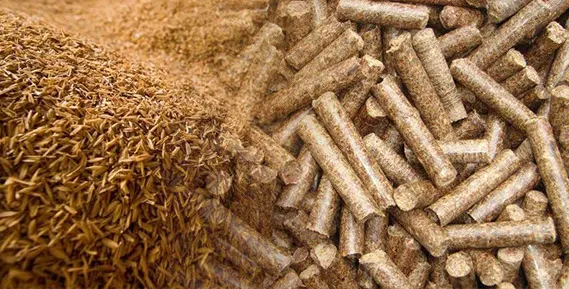
Pelletizing does not fundamentally change the chemical origin of the material. Instead, it changes its physical form. Loose rice husks can be difficult to transport efficiently because they have relatively low bulk density and occupy a large volume. Compression produces a denser and more uniform fuel.
The concept sounds straightforward, but rice husk has some characteristics that make it different from woody biomass. Its relatively high ash and silica content, distinctive fibrous structure, and abrasive nature can influence equipment selection and operating conditions.
Understanding these properties is therefore the first step toward designing a practical pellet production process.
What Makes Rice Husk Different From Wood Residues?
Rice husk is primarily a lignocellulosic agricultural residue, but it contains a relatively high proportion of mineral components, particularly silica. This characteristic is important when rice husk is considered as a combustion fuel.
Wood residues such as sawdust often have different ash characteristics and behave differently during grinding and pelletizing. Rice husk can be more abrasive, which means that wear on grinding and pelletizing components deserves attention.
The material is also naturally lightweight and bulky before compression. A large storage area may therefore be required if rice husks are stored in their loose form.
These differences do not mean that rice husk is unsuitable for pellet production. Rather, they show why a biomass pellet system should be designed around the specific feedstock instead of using exactly the same configuration for every agricultural residue.
Particle size, moisture content, ash content, contamination, and intended combustion application should all be evaluated before equipment is selected.
How Is Rice Husk Prepared Before Pelletizing?
Raw-material preparation generally begins with receiving and cleaning.
Rice husks from a modern rice mill may already be relatively clean, but contamination can still occur during transportation and storage. Stones, metal fragments, soil, plastic, and other foreign materials should be removed as much as practical.
Magnetic separation can help remove ferrous metal, while screening or other separation methods may be used for larger contaminants.
Unlike some agricultural stalks, rice husk may not always require intensive grinding because the material is already relatively small and thin. Whether additional size reduction is necessary depends on the pelletizer and the desired pellet specifications.
This can be an important advantage when designing the process. If the incoming husk already has an appropriate particle structure, unnecessary grinding can be avoided, reducing both equipment requirements and energy consumption.
However, a sample test is still useful because the physical characteristics of rice husk can vary according to rice variety, milling method, moisture, and storage conditions.
Does Moisture Matter When Making Rice Husk Pellets?
Moisture is one of the most important variables in biomass pellet production.
During compression, moisture can influence friction, temperature, particle bonding, and pellet durability. If the feedstock contains too much water, the material may be difficult to compress consistently and the finished pellets may become soft or unstable.
If the material is excessively dry, pellet formation may also become less predictable.
The suitable moisture range is not necessarily identical for every biomass material or every pelletizing machine. Equipment design, die configuration, particle size, and raw-material properties all influence the process.
For this reason, operators should measure moisture instead of judging it solely by touch or appearance.
One useful approach is to test representative samples from different batches. Rice husk stored under a roof may have significantly different moisture characteristics from material exposed to rain or humid outdoor conditions.
Consistent moisture control can make the pelletizing process more stable and reduce variations in finished-pellet quality.
What Is a Rice Husk Pellet Mill Used For?
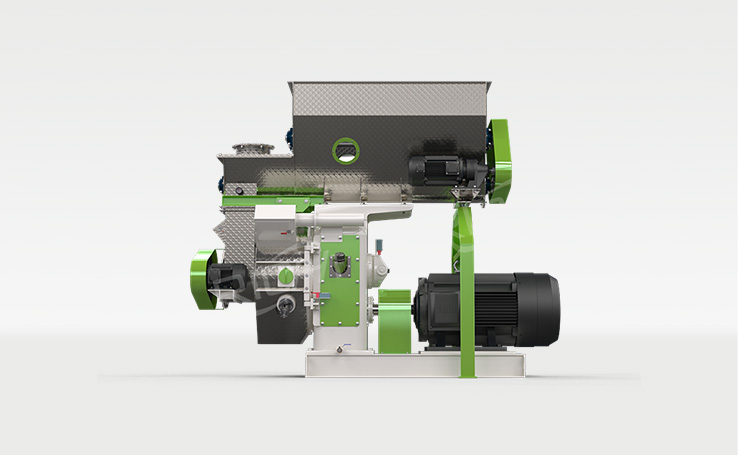
A rice husk pellet mill is designed to compress prepared rice husk into cylindrical or similarly shaped fuel pellets.
The material enters the pelletizing chamber through a controlled feeding system. Inside the chamber, compression forces the biomass through holes in a die. As the compressed material passes through the die, it forms continuous strands that are cut into pellets.
Pressure and friction generate heat during the process. Under suitable conditions, components naturally present in the biomass can contribute to particle bonding.
The actual performance of the machine depends on more than its rated motor power. Feedstock moisture, particle structure, die specifications, feeding stability, and operating conditions all influence production.
A machine that performs well with one biomass material may not deliver identical results with another. This is why test runs using actual rice husk can provide valuable information before a large installation is finalized.
Does Rice Husk Need a Dryer?
Not every rice husk project requires a dedicated dryer.
If the material is already sufficiently dry when it leaves the rice mill and remains protected during storage, the production process may be able to operate without intensive drying.
However, rice husk collected from humid environments or stored under unsuitable conditions can absorb moisture. If its moisture level becomes too high, drying may become necessary before pelletizing.
Drying equipment should therefore be considered according to actual material conditions rather than automatically included in every plant.
For larger facilities, a continuous moisture-management system may be useful because incoming material can vary throughout the year.
The choice of drying technology depends on available heat sources, feedstock moisture, production capacity, local climate, and operating costs.
A practical design should balance the energy consumed during drying against the amount of moisture that actually needs to be removed.
How Does an Agricultural Biomass Pellet Production Line Work?
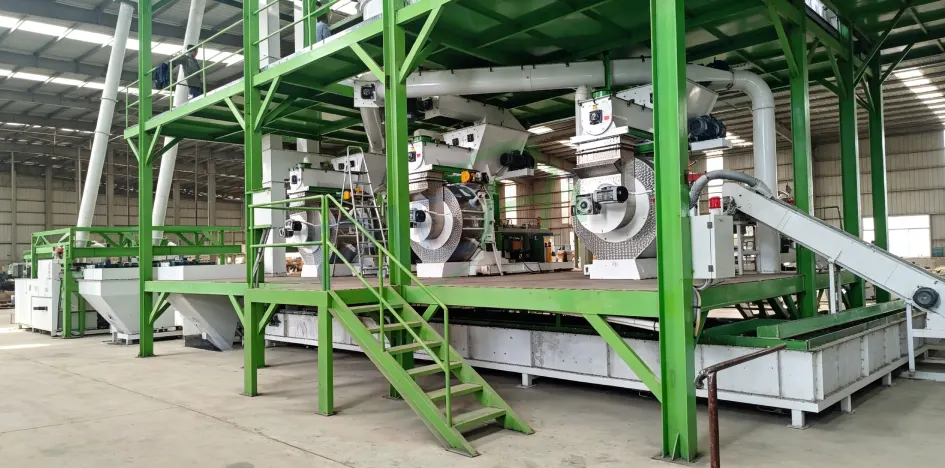
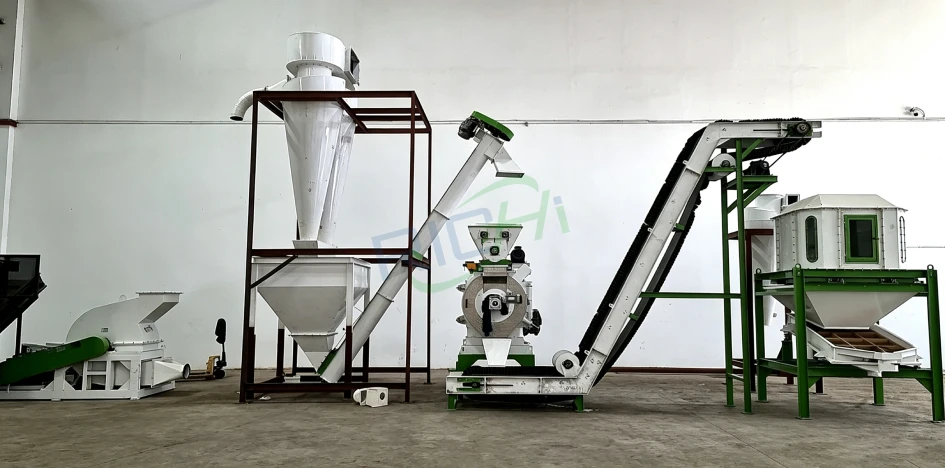
A complete agricultural waste biomass fuel pellet production line can contain several interconnected stages.
A relatively simple process may follow this sequence:
Raw-material receiving → cleaning → size adjustment if necessary → moisture adjustment → pelletizing → cooling → screening → storage
Larger installations can include automated feeding, conveyors, dust collection, weighing, packaging, and centralized control systems.
The exact configuration depends on the raw material. Rice husk is already relatively small, so its preparation process may be different from a line processing long corn stalks or large wood chips.
This is an important principle in biomass engineering: the production line should follow the material, not the other way around.
If the raw material is clean and dry, fewer preparation stages may be needed. If it contains excessive moisture or foreign matter, additional equipment becomes necessary.
A well-designed process therefore begins with a material assessment and then determines which machines are genuinely required.
What Happens After Rice Husk Is Pelletized?
Freshly produced pellets are usually warmer than the surrounding environment because of friction and compression during pelletizing.
They may also contain residual moisture that needs to be managed before storage.
A cooling system allows the pellets to release heat and stabilize. After cooling, screening can separate undersized particles and fines from the finished product.
Fines can sometimes be returned to the pelletizing process rather than discarded.
The final pellets can then be conveyed to storage bins, warehouses, silos, or packaging equipment depending on the scale of the operation.
Cooling and screening are sometimes overlooked when people focus primarily on the pelletizing machine. In reality, these downstream stages can have a direct effect on handling quality.
Pellets that are not properly cooled may experience storage problems, while excessive fines can make transportation and automated feeding less convenient.
Why Is Pellet Density Important?
Pellet density affects how much material can be stored or transported within a given volume.
Loose rice husks have a relatively low bulk density. This means that a truck or storage area may contain a large volume of material without containing a correspondingly large mass.
Compression changes this relationship by producing a denser form.
Higher bulk density can make transportation and storage more efficient, although the exact improvement depends on pellet characteristics and handling conditions.
Density should not be considered independently from durability. A pellet that is dense but easily breaks apart may generate excessive fines during transportation.
Therefore, quality evaluation should consider several properties together, including moisture, density, durability, dimensions, and ash content.
Does High Silica Content Affect Rice Husk Fuel?
Yes. Silica is one of the most distinctive characteristics of rice husk.
The mineral component can contribute significantly to the ash remaining after combustion. This is important because ash behavior can affect combustion equipment, ash handling, and maintenance.
Depending on combustion conditions, mineral deposits or slagging-related problems may occur in some systems. The actual effect depends on the fuel composition, combustion temperature, furnace design, and operating conditions.
This is why rice husk pellets should not automatically be treated as identical to wood pellets.
Before using them in a particular boiler or heating system, the fuel’s properties should be compared with the equipment manufacturer’s requirements.
Ash analysis can be particularly useful for commercial applications. It provides a more reliable basis for understanding the fuel than appearance alone.
Can Rice Husk Be Mixed With Other Biomass?
Blending is possible in many biomass applications, provided that the characteristics of each feedstock are understood.
Rice husk can potentially be combined with materials such as sawdust, wood residues, or certain agricultural by-products.
The reason for blending may vary. A producer may want to balance seasonal raw-material availability, adjust moisture, modify pellet properties, or use residues that would otherwise have limited value.
However, blending should be based on testing rather than simply combining equal quantities of different materials.
Different feedstocks can have very different ash contents, moisture requirements, bulk densities, and pelletizing characteristics.
For example, adding a low-ash woody material to a high-ash agricultural residue changes the overall composition of the final fuel, but it does not automatically eliminate all ash-related considerations.
The final mixture should therefore be evaluated as its own fuel rather than assuming that its properties will be the average of the individual materials.
What Should Be Considered When Designing a Rice Husk Pellet Plant?
The first question should be raw-material availability.
A plant needs a sufficiently stable supply of rice husk to justify its operating capacity. Seasonal fluctuations can become important in areas where rice milling activity varies significantly throughout the year.
The second question concerns material quality.
Moisture, ash, contamination, particle size, and storage conditions should be documented. These characteristics determine which preparation stages are needed.
The third question is production capacity.
Capacity should be connected to actual raw-material supply and fuel demand. Installing a very large system does not automatically make sense if the available feedstock cannot support continuous operation.
The fourth question is process layout.
Material should move logically from receiving through preparation, pelletizing, cooling, screening, and storage. Unnecessary conveying distances can increase energy consumption and complicate maintenance.
Finally, operators should consider future expansion. If production is expected to increase later, the initial layout can be designed with additional equipment or storage capacity in mind.
How Much Space Does a Biomass Pellet Facility Need?
There is no universal plant size because space requirements depend on capacity and process configuration.
A small system may only need space for raw-material storage, the processing equipment, finished-pellet storage, and basic access routes.
Larger facilities require additional areas for trucks, raw-material receiving, drying, conveyors, electrical equipment, dust collection, maintenance, and finished-product handling.
Raw-material storage can sometimes occupy a surprisingly large proportion of the site.
This is because loose rice husks have a relatively low bulk density. If large quantities are accumulated before processing, storage volume can become a major design consideration.
Finished pellets require less volume per unit of mass, but they still need to be kept dry and protected from contamination.
Good plant planning therefore considers both incoming and outgoing material flows.
How Can Pellet Quality Be Monitored?
Quality control does not necessarily require complicated laboratory equipment for every production batch.
Operators can begin with basic checks such as moisture measurement, visual inspection, pellet dimensions, and the amount of fines generated during handling.
For more detailed evaluation, laboratory testing can determine heating value, ash content, moisture, durability, and other relevant characteristics.
The appropriate testing frequency depends on the scale and purpose of the production facility.
For a commercial fuel producer, regular testing can help identify changes in incoming raw materials. A sudden increase in moisture or ash may indicate a change in harvesting, transportation, or storage conditions.
Keeping production records is also useful. Operators can compare pellet quality with changes in raw-material moisture, machine settings, and production rates.
Over time, these records can help establish more consistent operating conditions.
What Should Buyers Ask Before Choosing Equipment?
Equipment selection should focus on technical compatibility rather than a single headline capacity.
Potential users can ask for information about recommended feedstock moisture, acceptable particle size, expected output under specific conditions, motor configuration, die specifications, wear-part replacement, and maintenance requirements.
It is also worth asking whether the supplier can conduct a test with actual rice husk.
A theoretical production figure is less informative if it was measured under conditions that differ substantially from the intended project.
Technical documentation is another useful reference. Clear information about installation, operation, lubrication, maintenance, and spare parts can make long-term equipment management easier.
For larger projects, the design of the complete production process should also be reviewed. A pelletizer cannot compensate for an undersized dryer, unstable feeding system, poor storage conditions, or inadequate cooling capacity.
Where Can More Information About the Manufacturer Be Found?
When researching biomass-processing equipment, it can be useful to understand the background of the manufacturer as well as the technical specifications of individual machines.
Information about manufacturing experience, product categories, engineering capabilities, and project applications can help provide context when comparing different equipment suppliers.
For readers who want to review company information directly, straight from the source provides access to the manufacturer’s “About Us” page.
This type of background information should be considered alongside actual technical data, feedstock testing, operating requirements, and local project conditions.
The goal is to understand whether the proposed equipment configuration matches the material and process, rather than selecting machinery solely from photographs or advertised capacity.
Is Rice Husk Pelletizing Suitable for Every Rice-Producing Area?
Not necessarily.
The technical feasibility of pelletizing depends on several local factors. The first is the quantity and continuity of rice husk supply.
The second is transportation. If rice mills are widely dispersed, collecting and transporting loose husks over long distances may reduce the practical benefits of pelletizing.
The third is energy availability. If the raw material requires substantial drying, the project needs an appropriate and economical heat source.
The fourth is local demand. Producing pellets is only one part of the process; there also needs to be a suitable application or market for the finished fuel.
These factors should be evaluated together before a project is developed.
In some locations, direct combustion at a rice mill may be more practical. In others, pelletizing may provide a way to consolidate residues from multiple sources into a standardized fuel.
What Are the Main Advantages of Pelletizing Rice Husk?
The most obvious physical benefit is increased density.
Pellets occupy less volume than loose rice husks for the same mass, which can simplify transportation and storage.
A standardized shape can also make automated feeding easier. Pellets can be conveyed, stored, weighed, and packaged using equipment designed for uniform solid fuels.
Pelletizing can also help convert a dispersed agricultural residue into a more manageable energy product.
However, these benefits should be considered alongside the energy consumption and equipment investment required for processing.
Pelletizing is not simply a matter of compressing material. Drying, grinding where necessary, conveying, cooling, screening, storage, and maintenance all consume resources.
A technically sound project therefore evaluates the complete material and energy flow.
What Is the Best Way to Start a Rice Husk Pellet Project?
Starting with the feedstock is usually the most practical approach.
Collect representative samples from the actual rice mills or storage locations that will supply the project. Measure moisture and examine contamination. If possible, conduct laboratory analysis for ash and heating value.
Then determine the expected annual and daily supply.
Once the material is understood, define the desired pellet specifications and production capacity.
Only after these questions are answered should the equipment configuration be developed.
A pilot test can be particularly useful for unfamiliar feedstocks. It can reveal whether additional grinding is required, whether drying is necessary, and how the material behaves during compression.
This approach reduces the risk of designing a production system around assumptions that do not match the actual raw material.
Conclusion
Rice husk is a distinctive agricultural residue with characteristics that make it both useful and technically interesting as a biomass fuel feedstock. Its low bulk density makes loose handling inefficient in some situations, while its mineral and silica content requires attention when the resulting fuel is burned.
Turning rice husk into pellets involves more than compression. Cleaning, moisture control, particle preparation, pelletizing, cooling, screening, storage, and quality testing all contribute to the final result.
The appropriate process depends on local raw-material conditions, production capacity, fuel requirements, transportation distance, and available infrastructure.
For equipment research, wood pellet machine can be considered as one source of technical information when comparing pelletizing solutions. The more important principle, however, is to match the equipment to the actual biomass rather than assuming that one configuration works for every agricultural residue.
A well-planned rice husk pellet project begins with a clear understanding of the material. Once moisture, ash, particle structure, supply volume, and intended fuel application are established, the rest of the production process becomes much easier to design logically.