




Wood materials such as sawdust, wood chips, wood shavings, bark, and forestry residues often contain too much moisture for direct use in biomass pellet production, briquetting, combustion, and other applications. Controlling this moisture is therefore an important part of wood processing.
A rotary dryer is one of the commonly used industrial drying systems for continuous biomass processing. It uses controlled heat and airflow to evaporate moisture from wood materials while continuously moving the material through a drying chamber.
For sawdust processing, a properly designed rotary sawdust dryer can provide stable moisture reduction and prepare the material for downstream pelletizing or other applications. However, the performance of a rotary dryer depends on many factors, including initial moisture, particle size, heat source, airflow, residence time, feed rate, and target moisture.
Understanding how rotary dryers work can help biomass processors select suitable equipment and operate the drying system more efficiently.
What Is a Rotary Dryer?
A rotary dryer is an industrial drying machine that uses a rotating cylindrical drum to continuously process wet materials.
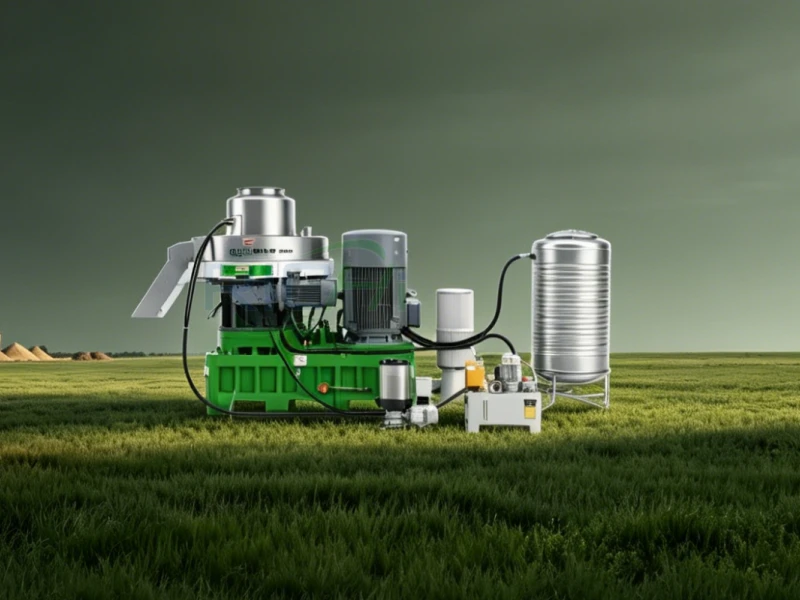
The basic system normally consists of:
- Feeding equipment
- Rotary drum
- Drive system
- Heat source
- Hot-air system
- Exhaust fan
- Dust collection equipment
- Discharge system
- Temperature sensors
- Electrical control system
The drum rotates at a controlled speed while the material moves gradually from the feed end toward the discharge end.
At the same time, hot air passes through the drying chamber and transfers heat to the material.
Moisture evaporates from the wood and is carried away by the exhaust air.
The dried material then leaves the dryer and moves to the next processing stage.
(Learn more: https://pelletisingmachine.com/rotary-dryer-machine/)
Why Are Rotary Dryers Used for Wood Materials?
Wood residues can have different moisture levels depending on their source and storage conditions.
Sawdust from fresh wood processing may contain relatively high moisture. Wood chips stored outdoors may also absorb rain and humidity.
If wet material is sent directly to a pellet mill, several problems may occur.
These may include:
- Unstable pelletizing
- Lower production capacity
- Increased energy consumption
- Poor pellet durability
- Inconsistent pellet quality
- Difficult material handling
A rotary dryer helps reduce excessive moisture before the material enters the next processing stage.
For large-scale biomass processing, continuous drying is particularly important because the dryer must process material at a stable rate over long operating periods.
Basic Working Principle of a Rotary Dryer
The basic working principle is relatively straightforward:
Wet wood material → feeding → heat transfer → moisture evaporation → moist-air removal → dried material discharge
However, several physical processes occur simultaneously inside the dryer.
First, wet material enters the rotating drum.
Second, the rotating drum continuously lifts and drops or redistributes the material.
Third, hot air contacts the material.
Fourth, heat transfers from the hot air to the wood.
Fifth, moisture inside the wood moves toward the surface and evaporates.
Finally, the humid air leaves the dryer while the dried material continues toward the discharge end.
The effectiveness of this process depends on achieving good contact between the hot air and the material.
The Structure of a Rotary Sawdust Dryer
A rotary sawdust dryer normally includes several major components.
Rotary Drum
The drum is the main drying chamber.
It is normally cylindrical and rotates around its central axis.
The size of the drum depends on the required drying capacity and material characteristics.
Drive System
The drive system rotates the drum at a controlled speed.
It may include a motor, gearbox, gear system, chain drive, or other transmission components depending on the design.
Lifting Structures
Internal lifting flights or similar structures help distribute the material inside the drum.
As the drum rotates, the material is lifted and then falls or moves through the hot-air stream.
This increases contact between the material and heated air.
Feeding System
The feeding system delivers wet wood material into the drum.
Stable feeding is important because sudden changes in feed rate can affect final moisture.
Discharge System
The dried material leaves the drum through the discharge section.
The discharge system should provide stable material flow toward the next processing stage.
How Heat Is Supplied
The dryer requires a source of thermal energy.
A separate heating system generates hot air, which then enters the drying chamber.
Possible heat sources include:
- Biomass fuel
- Natural gas
- Diesel
- Other industrial fuels
- Recovered process heat
The appropriate heat source depends on local fuel availability, operating cost, environmental requirements, and project scale.
For biomass plants, available wood residues may sometimes be used as fuel if a suitable combustion and hot-air system is installed.
How Hot Air Dries Wood
Hot air provides the thermal energy needed to evaporate water.
When wet sawdust enters the dryer, heat transfers from the hot air to the material.
As the wood warms, water inside the particles begins to move toward the surface.
At the surface, water changes into vapor and enters the surrounding air.
The exhaust system then removes this humid air from the dryer.
This continuous cycle allows moisture to be removed from the wood.
The drying process can therefore be understood as a combination of:
Heat transfer + moisture migration + evaporation + humid-air removal
Direct and Indirect Drying
Rotary dryers can use different heat-transfer configurations.
Direct Drying
In direct drying, hot air comes into direct contact with the material.
This is commonly used for many biomass drying applications because it provides efficient heat transfer.
Indirect Drying
In indirect systems, the material is heated through a separate heat-transfer surface, while the combustion gases do not directly contact the material.
The appropriate configuration depends on the material, application, heat source, product requirements, and environmental considerations.
For many wood biomass applications, direct hot-air drying is commonly considered because the process is relatively straightforward.
The Role of Airflow
Airflow is essential to rotary drying.
Hot air provides heat, while airflow carries evaporated moisture away from the material.
If airflow is too low, humid air may remain around the material and slow the drying process.
If airflow is too high, energy consumption and dust-handling requirements may increase.
Therefore, airflow should be matched to:
- Dryer size
- Material type
- Initial moisture
- Particle size
- Heat input
- Required throughput
Proper airflow distribution helps improve drying uniformity.
How the Rotary Drum Moves Sawdust
One of the most important features of a rotary dryer is the movement of material inside the drum.
Sawdust enters through the feeding end.
As the drum rotates, internal lifting structures pick up portions of the material and redistribute them.
This action exposes more material surface area to the hot air.
The material gradually moves from the inlet toward the outlet.
The movement speed depends on several factors, including:
- Drum rotation speed
- Drum inclination
- Internal lifting design
- Feed rate
- Airflow
- Material characteristics
The objective is to provide enough residence time for moisture evaporation without unnecessarily increasing energy consumption.
What Is Residence Time?
Residence time is the amount of time that the wood material remains inside the dryer.
If residence time is too short, the material may leave before reaching the required moisture.
If residence time is too long, the material may be over-dried and energy may be wasted.
Residence time is influenced by:
- Drum length
- Drum diameter
- Rotation speed
- Drum inclination
- Internal flights
- Feed rate
- Airflow
- Material particle size
The ideal residence time depends on the actual drying requirements.
How Initial Moisture Affects Drying
Initial moisture is one of the most important factors determining dryer performance.
If the material contains more water, the dryer must remove more water.
For example, two batches of sawdust processed at the same mass flow rate may require different amounts of heat if their initial moisture levels are different.
Higher initial moisture can result in:
- Greater heat demand
- Longer effective drying requirements
- Higher fuel consumption
- Lower effective throughput
Therefore, rotary dryer capacity should always be evaluated based on actual moisture conditions.
How Particle Size Affects Drying
Particle size also affects drying behavior.
Fine sawdust has a large surface area relative to its mass, which generally allows moisture to evaporate efficiently.
Larger wood chips may require longer drying because water inside the particles has to travel farther before reaching the surface.
Therefore, large wood materials may need chipping or crushing before entering the dryer.
A typical biomass processing sequence may be:
Wood waste → chipping → crushing → screening → drying → pelletizing
The exact process depends on the raw material.
How Moisture Moves Through Wood
Wood does not release all its moisture in exactly the same way.
Some water exists near the surface, while other moisture is located deeper inside the particles.
During drying, surface moisture can evaporate relatively quickly.
Moisture inside the material then migrates toward the surface.
This is why drying cannot be understood only as heating the outside of the wood.
Heat must penetrate the material while moisture must move outward.
Particle size, wood structure, temperature, and airflow all affect this process.
Why Higher Temperature Is Not Always Better
It may seem that increasing temperature will always make the dryer more efficient.
However, this is not necessarily true.
Higher temperatures can increase drying intensity, but they can also increase energy consumption and create unnecessary operating risks.
The correct drying conditions depend on:
- Material moisture
- Material size
- Heat-transfer characteristics
- Dryer design
- Airflow
- Residence time
- Target moisture
A properly designed rotary sawdust dryer should balance temperature and airflow rather than relying only on high temperatures.
How Exhaust Air Removes Moisture
As water evaporates from the wood, the air inside the dryer becomes more humid.
This humid air must be continuously removed.
An exhaust fan draws air through the drying system and transports it toward dust collection and discharge equipment.
The exhaust system therefore plays two important roles:
- Maintaining airflow
- Removing moisture vapor
Without effective exhaust, humid air can accumulate and reduce drying efficiency.
Dust Collection in Rotary Drying
Sawdust is a fine biomass material, so dust collection is an important part of the drying system.
Air moving through the dryer can carry fine wood particles.
A cyclone separator or other dust collection equipment can separate these particles from the exhaust air.
Depending on the system, additional filtration may be installed.
Dust collection can help:
- Reduce airborne particles
- Recover material
- Protect downstream equipment
- Improve the working environment
- Support safer biomass processing
Because fine biomass dust can be combustible under certain conditions, dust management should be incorporated into system design.
How a Rotary Dryer Controls Final Moisture
The final moisture of the material depends on the balance between moisture entering the dryer and moisture removed during drying.
Several operating parameters can be adjusted:
- Feed rate
- Hot-air temperature
- Airflow
- Drum speed
- Residence time
- Heat input
If the material leaves too wet, the operator may need to reduce feed rate or adjust the available drying conditions.
If the material becomes excessively dry, feed rate and heat input may need to be adjusted.
Modern drying systems can use temperature and moisture monitoring to improve process control.
Moisture Monitoring
Moisture measurement is useful at both the inlet and outlet of the dryer.
Incoming moisture measurements help determine the drying load.
Outlet measurements show whether the system is achieving the desired final condition.
For small plants, manual moisture testing may be sufficient.
For larger industrial plants, online moisture sensors can be integrated with the control system.
This allows the dryer to respond to changing raw material conditions.
How Rotary Dryers Work With Pellet Mills
For wood pellet production, drying is normally positioned before pelletizing when the raw material contains excessive moisture.
A typical process is:
Raw wood → crushing → grinding → drying → pelletizing → cooling → screening → packing
The dryer prepares the raw material for the pellet mill.
The pellet mill then compresses the dried material into pellets.
After pelletizing, the pellets are cooled and screened before packing.
The drying system must therefore be properly matched with pellet mill capacity.
If the dryer cannot supply enough dried material, it can become a bottleneck in the production line.
Why Dryer and Pellet Mill Capacity Must Be Matched
Suppose a pellet mill requires a continuous supply of several tons of prepared wood material per hour.
The drying system must be able to produce at least the required amount of properly dried material.
However, dryer capacity should be calculated based on wet feed rate and moisture removal, not simply dry material output.
This is particularly important when raw material moisture changes seasonally.
A well-designed production line should consider:
Wet material → drying capacity → dry material supply → pellet mill capacity
This helps maintain balanced material flow.
Energy Consumption of Rotary Dryers
Drying requires thermal energy because water must be evaporated.
Energy consumption is affected by:
- Initial moisture
- Target moisture
- Heat source
- Dryer efficiency
- Airflow
- Exhaust temperature
- Heat loss
- Feed rate
- Material characteristics
Reducing unnecessary moisture removal is one way to improve energy efficiency.
Proper insulation and stable heat generation can also reduce energy losses.
The objective should be to achieve the required moisture reduction with an appropriate amount of energy.
Common Problems With Rotary Wood Dryers
Although rotary dryers are relatively straightforward in principle, several operating problems can occur.
Material Leaves Too Wet
Possible causes include:
- Excessive feed rate
- High initial moisture
- Insufficient heat
- Insufficient residence time
- Poor airflow
Material Is Over-Dried
Possible causes include:
- Excessive heat input
- Low feed rate
- Excessive residence time
Moisture Is Uneven
Possible causes include:
- Uneven feeding
- Inconsistent particle size
- Poor material distribution
- Unstable airflow
Fuel Consumption Is Too High
Possible causes include:
- Excessive initial moisture
- Heat losses
- Inefficient heat source
- Over-drying
- Poor airflow management
How to Improve Rotary Dryer Performance
Several measures can improve drying performance.
Maintain Stable Feeding
Avoid sudden changes in material flow.
Monitor Moisture
Check both incoming and outgoing material.
Control Heat
Use an appropriate temperature rather than simply maximizing heat.
Optimize Airflow
Ensure sufficient airflow for heat transfer and moisture removal.
Maintain the Dryer
Inspect bearings, drive systems, drum components, fans, and conveyors regularly.
Prevent Moisture Reabsorption
Store dried material in a dry environment before pelletizing.
Match Capacity
Ensure the dryer can supply enough material for the pellet mill.
How to Choose a Rotary Sawdust Dryer
When selecting a rotary sawdust dryer, consider the following factors:
Material Type
Determine whether the dryer will process sawdust, chips, shavings, bark, or mixed biomass.
Initial Moisture
Measure the typical and maximum moisture content.
Target Moisture
Define the required final moisture.
Throughput
Calculate the wet material feed rate.
Water Evaporation
Determine how much water must be removed per hour.
Heat Source
Evaluate local fuel availability and energy costs.
Particle Size
Consider the material’s average and maximum particle size.
Factory Layout
Make sure there is sufficient space for the dryer, heat source, dust collector, fans, conveyors, and maintenance access.
Automation
Determine whether manual control or PLC-based automation is appropriate.
Maintenance of Rotary Dryers
Regular maintenance helps maintain stable operation.
Important components include:
- Drum
- Bearings
- Motor
- Gearbox
- Drive system
- Internal lifting components
- Feeding equipment
- Exhaust fan
- Dust collector
- Hot-air furnace
- Conveyors
- Sensors
Operators should regularly inspect moving components and check for abnormal noise, vibration, temperature, or material accumulation.
Worn components should be replaced according to maintenance requirements.
Safety Considerations
Wood drying involves heat and combustible biomass materials.
Therefore, safety should be considered in both equipment design and operation.
Important areas include:
- Heat source
- Dust collection
- Exhaust system
- Electrical equipment
- Hot surfaces
- Bearings
- Material accumulation
- Emergency shutdown systems
Fine wood dust can present combustible-dust hazards under certain conditions. Proper dust management and compliance with applicable local safety requirements are therefore important.
Operators should also receive appropriate training before operating the system.
Rotary Dryer Applications Beyond Pellet Production
Although wood pellet production is an important application, rotary dryers can be used for other biomass processing purposes.
Potential applications include:
- Biomass fuel production
- Wood briquette production
- Sawdust processing
- Wood waste utilization
- Biomass combustion preparation
- Agricultural residue drying
- Industrial biomass processing
The required drying conditions depend on the final product.
RICHI Rotary Drying Solutions
RICHI Machinery can design customized biomass drying systems according to raw material type, initial moisture, target moisture, required capacity, particle size, heat source, and downstream processing requirements.
For wood pellet production, a complete solution may include:
Raw material receiving → chipping → crushing → grinding → drying → pelletizing → cooling → screening → packing
The drying section can be equipped with the appropriate rotary drying system, feeding equipment, heat source, exhaust system, dust collection, conveying equipment, and electrical control.
For projects requiring a rotary sawdust dryer, RICHI can evaluate the complete moisture removal requirement rather than selecting the equipment based only on nominal throughput.
RICHI Manufacture also provides turnkey engineering services covering customized production line design, equipment manufacturing, overseas transportation and customs clearance, on-site installation and commissioning, operator training, and long-term after-sales follow-up.
Frequently Asked Questions
How does a rotary dryer dry sawdust?
A rotary dryer uses controlled hot air to transfer heat to sawdust while the rotating drum continuously lifts and moves the material. Moisture evaporates and is removed through the exhaust system.
What is a rotary sawdust dryer used for?
It is used to reduce excessive moisture in sawdust and similar biomass materials before pelletizing, briquetting, combustion, storage, or other processing.
What affects rotary dryer performance?
Major factors include initial moisture, target moisture, particle size, feed rate, heat source, temperature, airflow, residence time, and dryer design.
Can a rotary dryer process wet wood chips?
Yes, suitable rotary drying systems can process wood chips, but the dryer must be designed according to chip size, moisture, bulk density, and required throughput.
Does a rotary dryer use a lot of energy?
Drying requires thermal energy to evaporate water. Energy consumption depends mainly on initial moisture, target moisture, heat source efficiency, dryer design, and heat losses.
Can biomass be used as the dryer fuel?
In some projects, suitable biomass residues can be used as fuel. The combustion and hot-air system must be properly designed and operated.
How do I prevent sawdust from being over-dried?
Control the heat input, feed rate, residence time, and airflow. Moisture monitoring can also help maintain the desired final moisture.
Does a rotary dryer need dust collection?
For sawdust and other fine biomass materials, appropriate dust collection is generally an important part of the drying system.
Conclusion
Rotary dryers work by combining controlled heat, airflow, material movement, and moisture removal. Wet wood materials enter the rotating drum, where internal lifting structures continuously redistribute the material and expose it to hot air. Heat transfers into the wood, moisture evaporates, humid air is removed, and the dried material moves toward the discharge end.
For sawdust and similar biomass materials, a properly designed rotary sawdust dryer can provide continuous moisture control and prepare raw materials for pellet production and other downstream applications.
However, dryer performance depends on much more than the drum itself. Initial moisture, final moisture, particle size, feed rate, heat source, airflow, residence time, dust collection, and moisture monitoring all need to be considered.
For a complete wood pellet production project, the dryer should also be matched with grinding, pelletizing, cooling, screening, and packing equipment. By treating drying as part of the complete production system, manufacturers can achieve more stable material conditions, better energy efficiency, and more consistent finished products.